
Mandrel Release Lubricant Market Forecast 2026–2036: Market to Reach USD 1.0 Billion by 2036 at 6.8% CAGR
Rising adoption of mandrel-based forming processes and tighter surface quality standards drive steady market expansion
NEWARK, DE, UNITED STATES, February 23, 2026 /EINPresswire.com/ -- The global Mandrel Release Lubricant Market is projected to be valued at USD 0.5 billion in 2026 and is expected to reach USD 1.0 billion by 2036, reflecting a CAGR of 6.8% during the forecast period. Growth is primarily driven by increasing use of mandrel-based forming methods in tube and pipe manufacturing, composite fabrication, rubber processing, and precision metal forming applications.
Mandrel release lubricants are not general-purpose consumables but process-critical materials. Their role in ensuring clean part separation, stable surface finish, and consistent internal dimensions makes them integral to validated manufacturing recipes. As production lines prioritize throughput stability, reduced scrap, and longer tooling life, release lubricants are increasingly viewed as operational reliability enablers rather than low-visibility inputs.
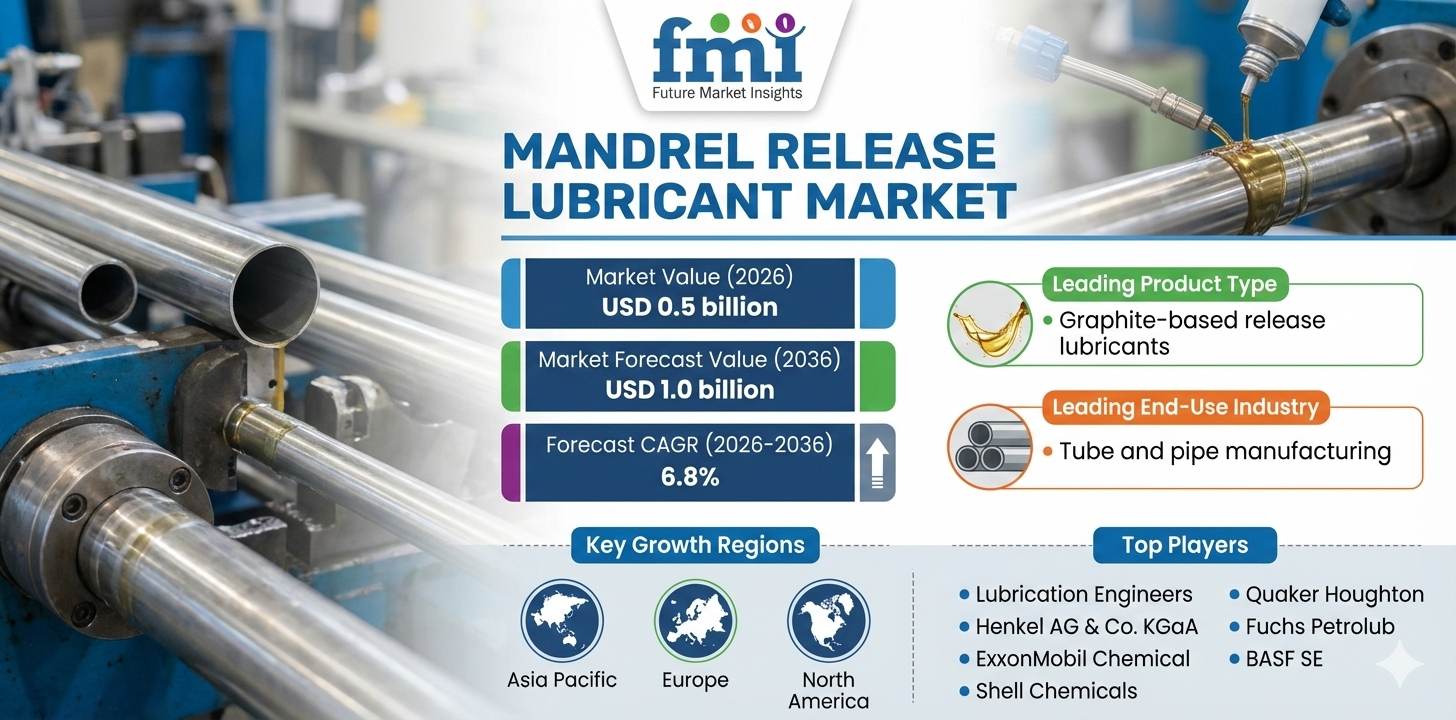
Mandrel Release Lubricant Market Snapshot (2026–2036)
• Market size in 2026: USD 0.5 billion
• Market size in 2036: USD 1.0 billion
• CAGR (2026–2036): 6.8%
• Leading product type: Graphite-based release lubricants
• Top end-use segment: Tube and pipe manufacturing
• Key growth regions: Asia Pacific, Europe, North America
• Core suppliers: Lubrication Engineers, Henkel AG & Co. KGaA, ExxonMobil Chemical, Shell Chemicals, Quaker Houghton, Fuchs Petrolub, BASF SE
Market Momentum
Between 2026 and 2029, market growth is supported by increased awareness of the operational risks associated with mandrel sticking, surface defects, and unplanned line stoppages. Many manufacturers are shifting decision-making authority from procurement to process engineering teams, recognizing that release performance directly influences yield, cleaning intervals, and cycle time stability.
From 2030 onward, as production cycles accelerate and tooling costs rise, demand increasingly reflects the need to protect mandrel assets and maintain predictable demolding behavior across long production runs. By 2036, the market reaches USD 1.0 billion, driven by higher lubricant usage intensity, more stringent surface finish requirements, and growing reliance on mandrel-based forming technologies.
Request For Sample Report | Customize Report |purchase Full Report - https://www.futuremarketinsights.com/reports/sample/rep-gb-31275
Why the Market is Growing
The Mandrel Release Lubricant Market expands in line with the structural importance of mandrel extraction reliability. In continuous tube, hose, and composite forming operations, even minor release failures can disrupt production, increase scrap, and shorten tool life. As manufacturers optimize for stable and repeatable cycle times, release lubricants become embedded in validated process recipes.
Once a lubricant is qualified for a specific mandrel surface, resin system, or forming temperature range, substitution is rare due to the risk of contamination, surface defects, or bonding interference. This qualification-driven environment favors suppliers capable of delivering batch-to-batch consistency, technical support, and application engineering expertise.
Segment Spotlight
Product Type: Graphite-Based Lubricants Lead Demand
Graphite-based release lubricants account for approximately 40% of market demand. Their ability to maintain lubricity under high temperature and pressure makes them particularly suitable for metal tube and pipe operations. While residue management can require additional cleaning, their performance under severe thermal loads sustains their dominant share.
Silicone-based, wax or emulsion, and PTFE-based formulations serve applications where surface cleanliness, downstream bonding compatibility, and minimal transfer are critical, especially in composites and elastomer processing.
End Use: Tube and Pipe Manufacturing Dominates
Tube and pipe manufacturing represents nearly 45% of total demand. This sector combines continuous production cycles, high forming forces, and strong reliance on mandrel shaping processes. Release reliability directly affects line uptime, yield, and tool replacement frequency, making lubricant selection a strategic process parameter rather than a routine purchase.
Composites and fiber-reinforced plastics, rubber and elastomer processing, and metal forming and extrusion also contribute to demand, though typically with longer cycles or lower throughput intensity compared to tube and pipe operations.
Country Growth Outlook (2026–2036)
India leads market expansion with a projected CAGR of 7.5%, supported by capacity expansion in automotive hoses, industrial tubing, and infrastructure-related manufacturing. China follows at 7.2%, driven by high-volume production and scale-based yield optimization initiatives. Brazil grows at 6.5%, reflecting steady demand from metal fabrication and composite sectors. The United States records 6.3% CAGR, with growth shaped by operational efficiency programs and replacement demand. The United Kingdom expands at 6.0%, supported by aerospace and specialty industrial applications requiring strict process validation.
Competitive Landscape
The Mandrel Release Lubricant Market is characterized by performance-driven competition centered on consistency, residue control, and application support. Companies such as Henkel AG & Co. KGaA, ExxonMobil Chemical, Shell Chemicals, Quaker Houghton, Fuchs Petrolub, and BASF SE compete on formulation stability, shear resistance, film uniformity, and compatibility with downstream coating or bonding processes.
Suppliers increasingly differentiate through technical trials, on-site process optimization, and the ability to align lubricant chemistry with specific mandrel substrates and curing environments. Success depends less on price competition and more on securing position within approved process specifications and long-term production programs.
Frequently Asked Questions (FAQ)
What is the projected size of the Mandrel Release Lubricant Market by 2036?
The market is expected to reach approximately USD 1.0 billion by 2036.
What is driving growth in this market?
Growth is driven by increased use of mandrel-based forming methods, higher tooling costs, tighter surface finish standards, and the need to reduce scrap and unplanned downtime.
Which product type leads the market?
Graphite-based release lubricants hold the largest share due to their performance under high temperature and high-pressure forming conditions.
Why is substitution uncommon once a lubricant is qualified?
Release behavior becomes part of the validated manufacturing recipe. Changing formulations can risk surface defects, sticking, contamination, and downstream bonding issues, making requalification costly and operationally disruptive.
Explore More Related Studies Published by FMI Research:
Particle Board Market https://www.futuremarketinsights.com/reports/particle-board-market
Anti-Reflective Coatings Market https://www.futuremarketinsights.com/reports/anti-reflective-coatings-market
Benzotrifluoride Market https://www.futuremarketinsights.com/reports/benzotrifluoride-market
About Future Market Insights (FMI)
Fture Market Insights, Inc. (FMI) is an ESOMAR-certified, ISO 9001:2015 market research and consulting organization, trusted by Fortune 500 clients and global enterprises. With operations in the U.S., UK, India, and Dubai, FMI provides data-backed insights and strategic intelligence across 30+ industries and 1200 markets worldwide.
Why Choose FMI: https://www.futuremarketinsights.com/why-fmi
Sudip Saha
Future Market Insights Inc.
+1 347-918-3531
rahul.singh@futuremarketinsights.com
Legal Disclaimer:
EIN Presswire provides this news content "as is" without warranty of any kind. We do not accept any responsibility or liability for the accuracy, content, images, videos, licenses, completeness, legality, or reliability of the information contained in this article. If you have any complaints or copyright issues related to this article, kindly contact the author above.
